One week after swearing in, I left for Lackland Air Force Base, San Antonio, Texas to start my Basic Training. It was Monday, April 26, 1971 and this would be the first time that I would be away from home.
Actually, I was excited and apprehensive at the same time about making this transition. I wanted to experience something different and I can say that without a doubt, I wasn't disappointed.
My parents drove me down to the airport in Huntsville, Alabama and waited with me in the terminal to board my flight. My wife was there and as young newly weds we were reserved at what to say at that moment. We knew that we would miss each other, but we also knew that it would only be for six weeks and we would be together again.
My mom was holding back tears as my flight was called to board. My dad didn't say much, but he never did. I'm sure that he was proud of me and believed that what I was doing was a good thing because he bragged to other family members about my joining the military.
I gave my farewells and boarded the plane. I was a little anxious because this was my first plane ride and as I looked out the window at the terminal as we were taxing, I couldn't help but think of how much my life was about to change. I was taking a big step in my life and for the first time, I would be making all the decisions without concern of what my dad would think or anyone else for that matter.
Upon arrival at the San Antonio Airport, I followed the instructions given to me earlier by my recruiter to meet my bus outside in front of the terminal. Other new recruits had arrived on the same plane and we all collected our bags and made our way to the buses that were lined up in rows outside the terminal. We stuffed our luggage under the belly of the bus and we boarded.
As I departed the airport on the bus, I looked out the window and reality set in. I realized at that moment that my life was about to change forever and that there was no turning back.
I arrived at Lackland Air Force Base Training Center on a bus with about 40 other young men. It was late in the evening. As the bus slowly came to a stop at the base reception center, I could see that other buses had arrived and young men were shuffling toe-to-toe in tight lines while displaying a look of total confusion on their faces.
A TI (Technical Instructor) stepped quickly up onto the steps of our bus and at that point … things really changed.
Flocks of large crows roosted in the trees outside the dining hall. We stood at Attention, in line, and the birds shat on us, while the TI's stood under the eaves and laughed as the warm, heavy, white shit plopped down on our caps and our shoulders like fitful rain. We stood perfectly still.
When we lined up for a meal, we moved sideways through the line, eyes straight ahead, and the servers threatened us; among the worst was a guy with just one stripe. We were given a blissful ten minutes to chow down. At the end of our first meal, TI's stood in wait at the tray window and any food left on our plates had to be eaten right then and there, stuffed into our mouths before we left the dining hall. After that, we all cleaned our plates. One night, we had Dixie Cups of ice cream. The flavor was Pink Champagne. It tasted the way bubble-bath smells. We ate it all.
The Chow Hall was not only visited for meals. We often were assigned KP, which stood for Kitchen Patrol. No, we didn't patrol the kitchen. Instead, we were given several different kitchen details. I remember one time, our flight had the duty and I got stuck with pots and pans. This was a hot, steamy, and nasty job.
When the cooks finished the shift cooking, all the large heavy pots and pans came my way. I stood in front of a large stainless steel sink that was twice as large as a normal one and used a hose with a high pressure sprayer to remove all the gunk from the pots and pans. The water was so hot; I had to wear thick black rubber gloves. I think the water was close to boiling temperature. I must have scrubbed and sprayed for hours at a time.
On one KP duty, I was fortunate to get on the serving line. At least I thought I was fortunate. I was fine until the end of the shift when I had to take all the left over food and scrape it off the plates into a large vat outside the chow hall. The mush inside the vat had a pungent odor that would nearly make you puke. I found out later that this vat of discarded food waste was sold to the local pig farmers for, you guessed it…pig chow!
He began shouting out orders that jump-started us out of our seats. I thought, what was HIS problem? Although I couldn't make out a single word of what he was shouting, I robotically followed the action of everyone else who was moving quickly off the bus and onto the pavement. Apparently, some of that loud unrecognizable slurred language that came out of the mouth of the TI translated into instructions to grab our luggage from under the belly of the bus and form some kind of a grouping outside of the bus. He then proceeded to bark off more instructions that, I think, included where we were going and something about how we now "belonged to Uncle Sam".
Two men in Smoky Bear hats, our TI's, arranged us by height into a rough formation. They showed us the position of "Attention". Heels together, toes slightly out, back straight, shoulders back, thumb and forefinger touching pant seam, eyes straight ahead, no motion, no sound, staring at the back of the head of the man in front of you. Wow, I never knew that I was standing the wrong way all these years!
"You will not move while at the position of Attention. There will be no picking of the nose while at the position of Attention." Ah, I thought, a little humor; this won't be so bad. "Cooperate and you graduate", one of them said. Okay, I was fine with that.
The two men introduced themselves as SSgt. Wilson and Sgt. Taylor. They said if anybody thought they could whip their ass they'd better step up front right now. I didn't understand that. No one moved. We then counted off, went inside, no ran inside the Reception Center. And then it started.
SSgt. Wilson just picked a recruit up by the shirt and slammed him into the wall and screaming into his face. No reason we could see. What was happening? Why was he so angry?
What had we done? Something was terribly wrong. 'Wrong from right,' I knew that. What was wrong?
SSgt Wilson yells, "You miserable little wise-ass. What are you looking at?" "What?", replied the recruit. Wilson again, "What were you looking at?" The recruit, "Nothing." Wilson, "What?" Recruit, "Nothing!" Wilson, "WHAT?" The recruit again, "I don't know!" the tears welling up in his eyes, shaking all over. SSgt Wilson replied quickly, "You don't know, SIR!" "I don't know, Sir!", replied the recruit shaking. "I can't HEAR you!" yelled Wilson. "I don't know, Sir!" replied the recruit. "I STILL CAN'T HEAR YOU!!" bellowed SSgt Wilson. "I DON'T KNOW, SIR!"
And then he was on the floor where he'd been dropped; trying to straighten up to the position of Attention, and SSgt. Wilson had gone on to someone else whose expression betrayed God knows what forbidden emotion.
We had to leave the barracks in inspection order every morning, before we could go to breakfast. This involved getting up, dressing, making the beds and then taking care of our details, whether one was in charge of bathrooms, hallways or the outside grounds. We arose at 5 a.m. We were in formation outside the barracks, in perfect order, at 5:05 a.m. Five minutes being a long period of time in Basic Training; we soon got it down to 5:03 a.m.. Perhaps you are thinking, "That's impossible!" Oh no, that's the first or second thing you learn; nothing is impossible!
At 4:59 a.m., the TI would walk in quietly and stand in the doorway of our bay, put one hand on the light switch, and tick off the seconds. At 5:00 a.m. he hit the lights and shouted, "GET UP!" He could probably be heard half a mile away. Inside the confines of the barracks, the noise was deafening. "GEEEEETUUUP!" In the first second, you sucked in an enormous breath of air, head coming up off the pillow, arms flailing, legs pumping, heart pounding, from sleep to bright panic in one second.
You had to be on the floor instantly, or you'd be thrown onto the floor by the TI. I saw one man sleep through the wake-up call; SSgt. Wilson pushed over his bunk, knocking two more beds down like dominoes, sending the man to the floor and creating a real mess that had to be cleaned up immediately. Twice, I literally woke up in mid-air, already moving before I was conscious. Once I landed on the guy in the lower bunk who was also trying to get up and out before disaster struck.
In the next few seconds we jumped into our uniforms that were left lying the night before in perfect order on top of our footlocker. The shirt was already buttoned; we pulled it over our heads; there was no time for buttons. We were dressed inside 30 seconds, unless we had to lace up combat boots and then it would take a full minute. The second minute was spent making the bed. We learned to sleep without moving, our knees high, so we wouldn't have to remake the corners at the bottom.
The bed would be perfect before the end of the second minute and then we had one minute to clean our detail. You could throw in a run to the bathroom if you were in agony, but that screwed up the latrine crew.
At two minutes and forty-five seconds, most everybody was outside, and I, being the Outside Man, could sweep any dust they'd raised off my concrete steps, carefully replace the broom in the rack, and slip into the formation as we were called to Attention.
We were all perfectly dressed; the barracks was spotless; we'd been awake for three minutes exactly. In the dark, we marched to breakfast. Quite often our flight was the third or fourth in line.
Flocks of large crows roosted in the trees outside the dining hall. We stood at Attention, in line, and the birds shat on us, while the TI's stood under the eaves and laughed as the warm, heavy, white shit plopped down on our caps and our shoulders like fitful rain. We stood perfectly still.
When we lined up for a meal, we moved sideways through the line, eyes straight ahead, and the servers threatened us; among the worst was a guy with just one stripe. We were given a blissful ten minutes to chow down. At the end of our first meal, TI's stood in wait at the tray window and any food left on our plates had to be eaten right then and there, stuffed into our mouths before we left the dining hall. After that, we all cleaned our plates. One night, we had Dixie Cups of ice cream. The flavor was Pink Champagne. It tasted the way bubble-bath smells. We ate it all.
The Chow Hall was not only visited for meals. We often were assigned KP, which stood for Kitchen Patrol. No, we didn't patrol the kitchen. Instead, we were given several different kitchen details. I remember one time, our flight had the duty and I got stuck with pots and pans. This was a hot, steamy, and nasty job.
When the cooks finished the shift cooking, all the large heavy pots and pans came my way. I stood in front of a large stainless steel sink that was twice as large as a normal one and used a hose with a high pressure sprayer to remove all the gunk from the pots and pans. The water was so hot; I had to wear thick black rubber gloves. I think the water was close to boiling temperature. I must have scrubbed and sprayed for hours at a time.
On one KP duty, I was fortunate to get on the serving line. At least I thought I was fortunate. I was fine until the end of the shift when I had to take all the left over food and scrape it off the plates into a large vat outside the chow hall. The mush inside the vat had a pungent odor that would nearly make you puke. I found out later that this vat of discarded food waste was sold to the local pig farmers for, you guessed it, pig chow!
The first thing they gave us was a key. We had a lock on our footlocker, and it was always kept locked. We wore the key on a chain around our neck. The chain was kept inside the shirt. A key outside the collar drew quick punishment.
Any temptation placed in the path of a fellow Airman was a Security Violation. An unlocked footlocker was a big Security Violation. Indeed, one dime left in a shirt pocket outside the locked footlocker was a terrible provocation. For that offense, one could get Correctional Custody (CC), a barracks set aside from the others, a real horror show for the hard-core. Looking back at this practice, I could see the relationship of how security became a much larger responsibility when I moved on into the "real Air Force".
I remember when one recruit left his footlocker unlocked one morning, while he was aligning everyone's shoes under their bunks, and was sent to CC for two long hours, which he spent either running or at the position of Attention.
It seemed to us that people were always taken to CC after dark. In the middle of the night, the TI on Squadron duty would tour each barracks looking for Security Violations, walking the outside aisles, rattling locks on footlockers, and checking shirt pockets. Most TI's wore a cleat on their left shoe, to keep time while marching. We'd wake and hear the cleat on the floor, clicking. We couldn't look up; that invited attention. So we held still, listening to the sound of the cleat moving around the room, coming closer.
I wore glasses. Glasses were "valuables." I could not lock them up in my footlocker because there was no time in the morning to unlock, open, close and lock a footlocker. So, like everyone else who wore glasses, I had to find a place to hide them. You couldn't sleep with them, because they might break. That left the laundry bag, inside some socks maybe, or hidden in your clothes. Inside a pocket was no good, because they checked to see if the pockets were buttoned. If not, that was out of inspection order, and they'd drag you out of bed for that, too. So the glasses were very carefully folded in the pant leg, where we could find them in the morning but too carefully folded for a TI to bother with in the dark, or so you hoped. And you'd lie in bed, frozen; listening to him going through your clothes, praying that he wouldn't find a problem.
The first nickname that you get when you arrive at Basic is "Rainbow". This refers to new recruits who still have their civilian clothing, thus, colors. My first night in the barracks was a little lonely. We were all put on an open-bay floor with rows of steel framed bunk beds. No walls, no privacy.
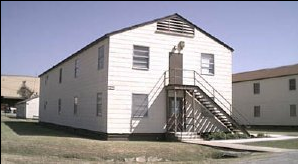
See photo on top
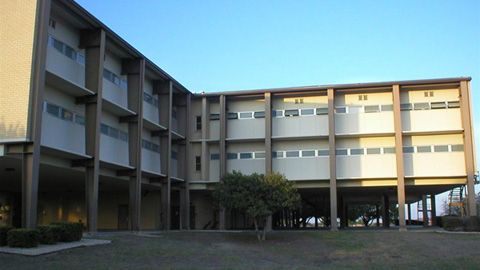
New Dorms (See photo on bottom).
The barracks was an old World War II building that was constructed out of wood planked siding and painted with several heavy coats of white paint.(See photo on left - New Airman Dorms, See photo on right. They were just building them when I was there.)
There were two floors that were identical with the exception of the TI's quarters on the second floor. New thousand man dormitories were under construction on the base, however, we were stuck in these buildings that should have been condemned ages ago.
The TI stays the first week in the barracks to keep an eye on everyone until we all learned the UCMJ (Uniform Code of Military Justice). These were the basic laws and foundation that we had to learn in the first week of training. Once we completed our class on the UCMJ, we were lawfully bound to follow them.
Each squadron of recruits had a "sister flight". This was usually their next door neighbor barracks. Your flight and the sister flight were always competing with each other. The TI's would put their flight up against another flight to promote competition among the recruits. Before our sister flight had gone through the UCMJ course, one of the recruits punched their TI while he was walking up the stairs to his quarters. The recruit wasn't punished because legally he didn't know the laws of the military yet and he couldn't be held responsible. Normally, if something like that happened, the TI would send the recruit back to the first day of training, but because the recruit didn't know military law and he was already in his first day of Basic, the TI couldn't do much.
After we were assigned a bunk, the TI and some of his buddies, had everyone dump our entire luggage out onto our bunks. They were searching for items that we wouldn't need, such as, food, books, radios, tape players (no we didn't have MP3's or CD's back then), or any other luxury. All nonessential items were put back into our luggage and stored away until we completed Basic Training.
We were taken over to a building where we were given twenty-five dollars. This money was paid to us for the purpose of purchasing hygiene items, such as, a toothbrush, shaving cream, razors, etc.
I wasn't accustomed to being away from home and now I had to sleep in a large open room with 24 other new recruits. During the night, you could here young men sobbing into their pillows trying to hide the fact that they were now alone without their mommy's. I felt sorry for them; however, I was feeling somewhat lonely as well but for a different reason. I'm sure that other young married men were feeling the same way. I don't think many slept very well that first night. I know that I didn't.
Very early on the following day, the TI stomped into our barracks and woke everyone up with "ARE YOU GIRLS GOING TO SLEEP IN ALL DAY?" I looked up at the military style clock on the wall and it was only 4:30 a.m. He gave everyone ten minutes to shower and get their clothes on and meet outside in formation. We performed our three-minute ritual and prepared to march off into whichever direction he wanted us to go. It was time to go 'green'!
Our first goal of the day was to get our new uniforms, our "pickle suits", as we called them. This was the first step in making everyone look the same. We formed this long human assembly line inside this huge building nicknamed, "The Green Monster". It looked like a clothing warehouse. We were sized by sight -- "Stand up... 36 long, next... 42 regular, next!" all the way through. People were shoving shirts, pants, socks, shoes, and hats into our open arms.
At the end we stood with a mountain of uniforms and were given a heavy canvas duffel, green like almost everything else, to fill. The duffel stood in a little rack, and one very short-tempered sergeant gave rapid instructions. "Boots, soles out in opposite directions, on their sides; dress blue pants; dress blouse (frantic whispers of "What's a blouse?"); shirts, three, blue dress..."
Part of the process of stripping away our personality involved the complete removal of all possessions, including clothes that belonged to our previous selves. And one of the most telling losses came at the moment we gave up our own underwear and pulled on uniform boxer shorts. They were white, wispy, and loose. No longer were our most sensitive parts held close to the body. They hung and swung in the breeze.
When it was over, if you had something left over, that's how they knew. Your entire flight had to wait for you while you re-packed with the next group, and you were given Dorm Guard duty from 12 midnight to 3 a.m. that morning.
A day, or perhaps just hours, after we received our uniforms, we were marched to a building where scores of middle-aged women, mostly Mexican, perspired over sewing machines. The room was long, hot and noisy, and we were not a welcome interruption. We wrote down our names and handed over our green fatigue shirts and when we returned, a few days later, each of our three shirts had a broad blue cloth strip over the pocket bearing our name in white capital letters. No stripe on the sleeve yet; that would come at the end of Basic.
The TI's were probably more familiar with the sewing ladies, as most had their uniforms tailored. And they were certainly more familiar with the laundry; every morning they appeared in a fresh uniform, pressed, starched, the seams ironed razor sharp. Even at our best, we looked dumpy in comparison.
The barbershops were these two small wooden structured buildings, much like our barracks, but smaller. One large wooden door opened on one side and on the opposite side another opened and exited the other side, which formed a straight pathway through the building.
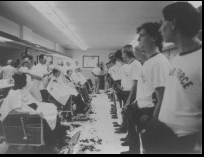
Remember, this was 1971, when most young men wore long hair, beards, mustaches, and long sideburns. The funny part was that as we stood in line, the TI instructed us that he wanted us to form up again on the other side of the building, after getting our haircuts, in the same order that we were currently in now. It was hilarious trying to find that guy who was just standing next to you earlier with the long hair. The TI's seemed to get a kick out of watching us look like fools scrambling around and looking at each other. We were on our way to losing our individualism, which was the point of the haircuts. Everyone looked so different, but closer to the same, after coming out of there.
Multitudes of freshly cut hair of different colors and textures piled in mounds on the barbershop floor as one barber constantly swept hair from under the chairs to make way for the other barbers to walk around. After a few swipes across your head, you were now unrecognizable. The beards, mustaches, and sideburns remained. After some useless searching for that once longhaired buddy, the TI told us to just get in formation.
While still in shock over losing our hair, we marched back to our barracks where everyone was given 10 minutes to shave off the additional facial hair. That didn't faze me so much, because I had taken my dad's advice and shaved before coming. I felt sorry for those who had the daunting task of trying to shave some pretty thick hair off of their faces. There were guys with these huge Elvis style side burns and long mustaches. After the 10 minutes was up, there were many bleeding faces. Oh yeah, those ten minutes the TI gave us, included cleanup.
Basic Training was very exciting. We learned how to properly fold our underwear, T-shirts, socks, and even our hankies. The old wooden World War II barracks were very hard to clean. We had to wax the floors once a week and dust everything. There was no air conditioning and let me tell you that summer in Texas is scorching. We did have these huge fans at the end of the barracks that blew warm air and of course more dust.
One of the ways we stayed tied together was by observing our gig line, an imaginary line running down the center of our shirt and pants that met at the waist, where the descending button placket of our shirt had to align perfectly with the fly of our trousers. If your gig line wasn't straight, you were gigged one demerit, in an inspection, or made to hand over a 341 (a form that you carried on your person) out in the wild. My gig line, something I was never aware of before Basic Training, was always straight. I still, to this day, find myself checking it every morning as I dress for work and after using the restroom.
I worked very hard at conforming to the military life and did pretty well at it until one day I goofed up. It was an inspection day and we marched off to an early breakfast. It looked as if it might rain that morning, so we carried our rain gear.
At the chow hall, we always put our rain gear under our chairs while we ate. Our rain gear consisted of a coat rolled up and tucked inside of a rain hat cover, which made a tight little bundle. We rushed through our usual ten-minute breakfast routine and then marched back to our barracks to prepare for inspection. After arriving at the barracks, I noticed that I didn't have my rain gear.
I was petrified. I was hesitant to tell TSgt Wilson, who was my TI, but I knew that I had to tell him because if I didn't have my rain gear we would get demerits from the inspectors. The TI's were graded on how they managed their flights and didn't take getting demerits lightly.
I built up the courage and told him that I had left my rain gear and he just looked at me and said, "Double-time back to the chow hall and see if it is still there!" I kept saying over and over to myself as I ran back to the chow hall, "Please be there, please be there!" I searched the entire chow hall under every chair and table, but of course it wasn't there. I ran back and reluctantly told TSgt Wilson. I could tell that he was disappointed. He took me upstairs into his office where he opened a locker and pulled out what must have been a spare rain suit and hat. He said, "Now go put this in you locker and prepare for inspection". It was at that time that I knew that he wasn't that bad of guy after all. He was after all, human.
One of us always stood as a silent sentry at the front door of the barracks; to "observe everything within sight or hearing," always ready to challenge any strangers who might approach and apprehend anyone who attempted to cross our post (open the screen-door) without proper authority. TI's from other barracks used to come to the door and demand entry, shouting until the Dorm Guard shook in his chukka boots. If the Dorm Guard responded to the direct order and let the TI pass, that was a violation of security, and then the shouting really began. The hardest part about being Dorm Guard was Rule 7, "I will not talk to anyone except in the line of duty." Three hours of standing still, unable to speak, with nothing to read but George Washington's order on profanity tacked on the bulletin board by the door.
One of the Dorm Guard's functions was to act as doorman when SSgt. Wilson or Sgt. Taylor came in or out. I snapped the door open so quickly one day, that Sgt. Taylor was prompted to say, "Greased lightning!" as he passed. It was the only compliment I ever received in Basic Training.
There was another TI who assisted TSgt Wilson three days a week and his name was Sgt Taylor. He was a short Hispanic guy who liked to pick on people. I think it was his nature because he was so small.
We quickly became terrified of movement, our own movement. A blink was okay, but a sniffle, a lick of the lips, a squint, and those types of displays invited attention of the worst kind. With 50 people standing at Attention, frozen solid, even the slightest movement stood out. You didn't want to stand out. You wanted to disappear.
There was one this time when we were doing marching practice and because I was a shorter person I ended up in the rear of the formation. The tallest people were put in the front of the formation and shorter people followed to give a nice tapered look down the line.
I wasn't the shortest by far, but I still ended up pretty deep in the lineup. Anyway, we were standing in formation "at Attention". This is where you stand upright, hands down to your side, eyes straight forward, and you can't move. I suddenly had this terrible itch along side my nose that was driving me crazy. I just had to scratch it, but dare I?
Sgt Taylor was moving forward and had just crossed the very front of the line, so I waited until he passed behind someone and could no longer see me so I took my chance and quickly reached up and rubbed that itch. It took only microseconds. Well, I thought everything was cool until I see him stepping down the lineup toward me. Surely he didn't see me! I thought. I felt confident that he was not coming to me. I was wrong.
He came down the line and stood directly in front of me. The top of his head came up to my chin. He looked up and brought his hand up and starting tapping me on the nose while repeating out loud, "You had to go and scratch you nose while in formation!" Now this was making my nose itch again, but I couldn't scratch it. It was a little embarrassing, to say the least, but not as bad as what happened to some of the other recruits.
I wasn't the only one who looked stupid during Basic. One young recruit had the hardest time folding and organizing his footlocker, so one day, just before inspection, the TI came around conducting a pre-inspection of us and the barracks. When he got to the recruit's locker, he fumbled through it for a few seconds and without warning, picked it up and threw it out the second floor window where it scattered onto the ground below. Shit went everywhere as the TI yelled to him, "You have 15 minutes to go down there, pick everything up and get it all up here in your locker in inspection order or you're going back to day one of Basic!" The TI knew damn well that it was physically impossible for the recruit to do this and most likely wanted him to go back to the beginning. This same recruit had problems getting some of the military movements exactly right. He couldn't salute properly because his fingers curved outward and he couldn't do an about-face, which is a rotating movement on your feet to change direction while marching. I think that the TI had just had enough and did the boy a favor. If he can't make it, he doesn't belong. It was how they weeded out the weak.
I felt kind of sorry for the guy, but after all, it was all about discipline. If the guy couldn't get it together and follow simple instructions, then he couldn't make it in the real military. He could actually get someone killed by not following orders.
Others joined the ranks of nonconformity. An exceptionally tall recruit made the mistake of folding his underwear improperly. I know that sounds trivial, but again, it comes back to following instructions. The TI reaches down into the recruit's footlocker and takes out the shaving cream and squirts it into a swirl around the top of the recruit's head and pulls a pair of underwear over his head and made him run up and down the barracks stairs repeating loudly, "I am a dipshit because I folded my underwear wrong!" Because he was so tall; it was funnier and looked so foolish. Although it was funny, we couldn't laugh or we would end up doing the same thing or worse. Man it was hard to hold back the laughter.
The fear of motion quickly became internalized. The first two days in the barracks, no one used the bathroom except for a quick stop at the lone urinal. (There was more than one, but the rest were off limits, kept pristine so only one would have to be cleaned thoroughly before inspection.) Five days, after arrival, was the average time before anyone even thought about sitting down on the toilet and there were cases of a two-week wait for the first bowel movement.
Our flight was sent to a building and lined up, heel to toe as always, for fingerprinting and photography for our military identity card. For the picture, we were ordered not to smile, which was not hard, but I tried to look defiant. Instead, I just looked like I felt. The fingerprinting, which was forwarded to the FBI's central file in case any of us chose a life of crime, was more interesting. A fingerprint technician, who probably didn't really enlist for this job, held our fingers and rolled them first on an inked plate of glass, and then on a card, one finger at a time. Any smudges and you started over, so you didn't want to smudge. The key to the process was relaxing your hand. For some trainees, a fear of screwing up and the foreign feeling of someone else guiding their fingers caused their hands to stiffen and tremble. And so, periodically, you'd see the fingerprint technician take someone's hand and repeatedly smash it on the countertop, boom, boom, boom, until they loosened up. We all tried very hard to relax.
I could tell more about Basic Training, such as, the Confidence Course, the psychological B.S., and other things, but I have rambled on way too much.
Six weeks of Basic went by pretty fast and it all finally came to an end. After the graduation ceremony on June 7, 1971 (See photo below), I walked up to TSgt Wilson who was sitting down and I reached out to shake his hand. With a puzzled look, he asked, "Why?" and I said, "I just wanted to thank you for teaching me how to be a man and that I hold no hard feelings. You were just doing your job". He hesitated for a short, stood up, and reached out and firmly shook my hand. His eyes were welling up as he said in a firm voice, "Your welcome, Airman Moland". I actually think to this day, that no recruit has ever said that to him. That was the first time that he had every called my anything other than recruit Moland. It felt good.
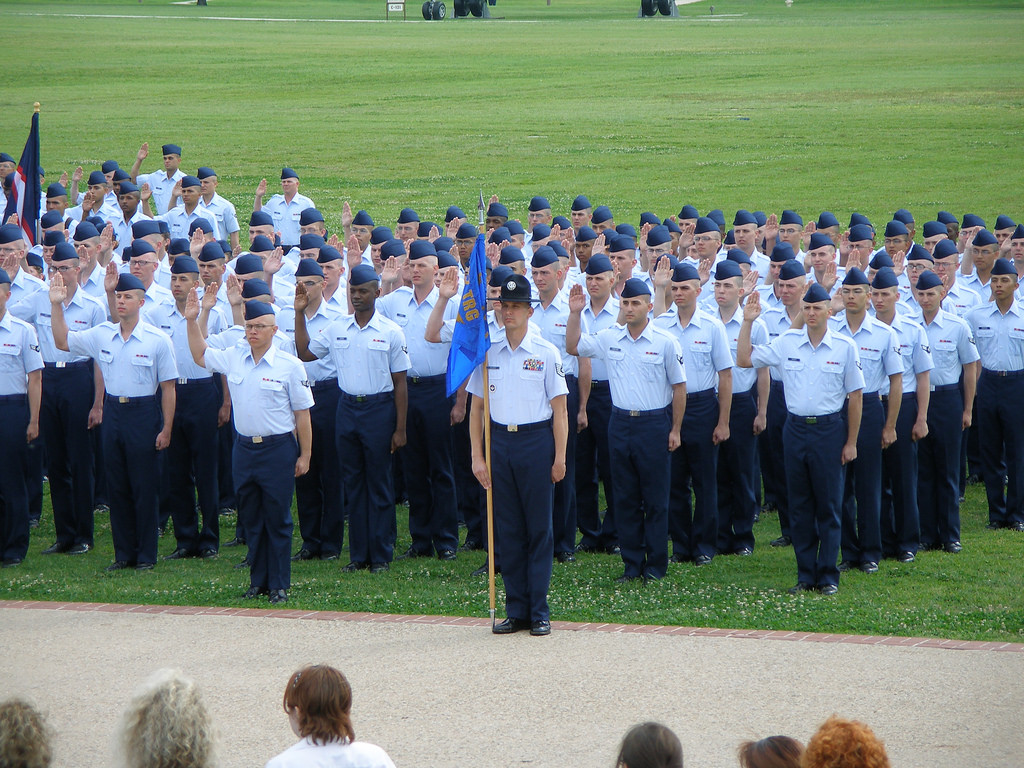
Graduation also signaled that we were receiving our new orders to our school for training into our new jobs and mine was Air Passenger Specialist Technical School at Sheppard Air Force Base, Wichita Falls, Texas.